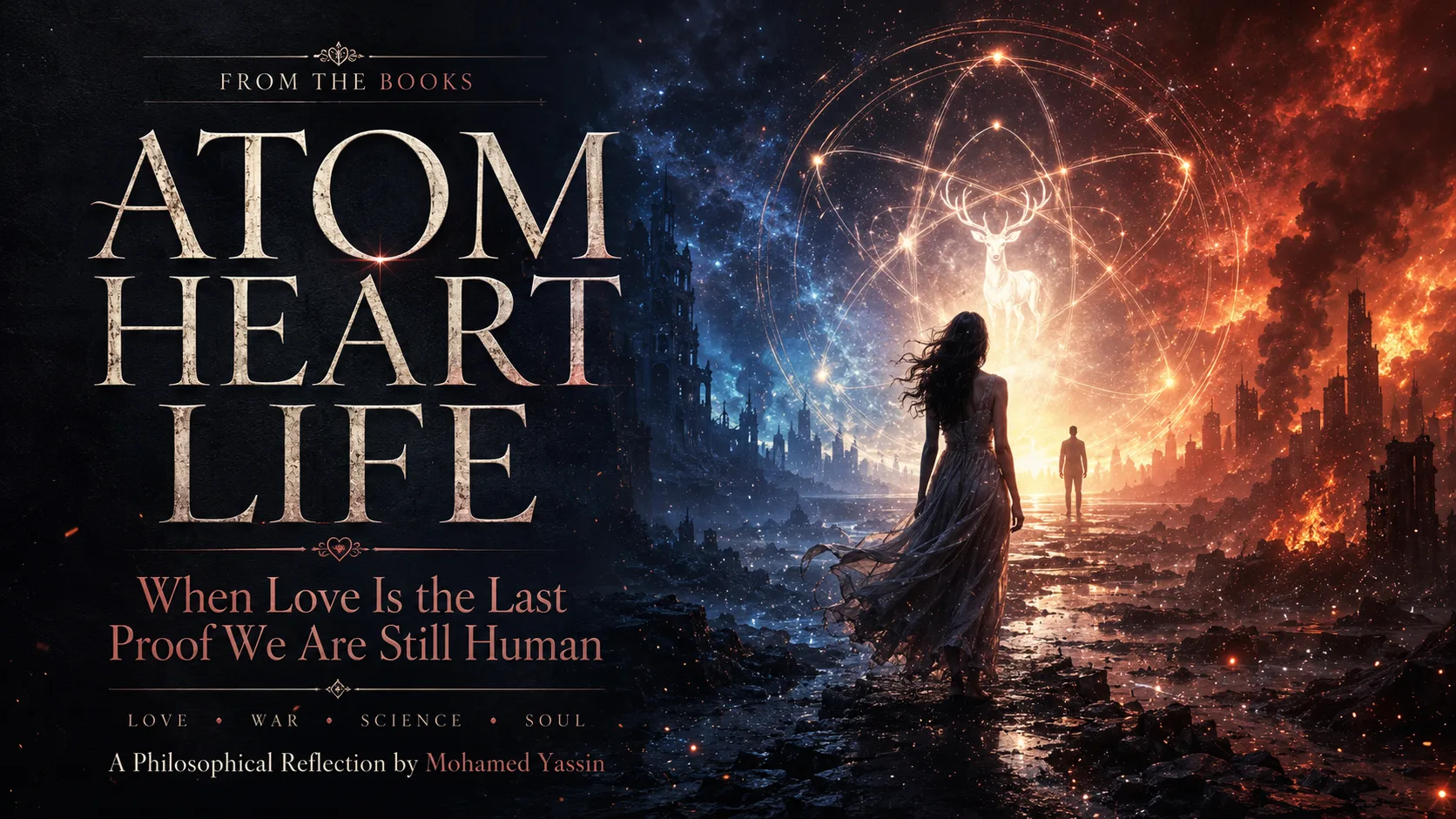
Atom Heart Life — When Love Is the Last Proof We Are Still Human
What if the end of humanity does not begin with war, disease, or collapsing cities — but with the moment the heart becomes too silent to resist them?
What if the end of the world does not begin with bombs?
What if it does not begin with disease, collapsing cities, or the smoke of war?
What if it begins much earlier?
In the quiet moment when human beings become intelligent enough to change life — but not wise enough to protect it.
Atom Heart Life: Odyssey of Love and War is not only a story about love in a wounded world.
It is a question placed inside a novel.
A question about humanity.
A question about science.
A question about power.
And above all, a question about the soul.
The World Does Not Collapse Suddenly
The world in Atom Heart Life is not destroyed in one moment.
It is slowly weakened by ambition without conscience.
By progress without humility.
By power without mercy.
By systems that know how to control people, but have forgotten how to protect them.
This is what makes the story disturbing.
It does not feel like a fantasy that belongs far away.
It feels like a warning whispered from somewhere close.
The book does not simply ask, “What if war comes?”
It asks something more painful:
What if war is only the visible symptom of a deeper illness?
What if the real collapse begins when humanity accepts cruelty as strategy, greed as progress, and emotional numbness as maturity?
This is where the story becomes more than fiction.
It becomes a mirror.
Juliet’s Nightmare Is a Warning
Juliet’s vision of the battlefield is one of the emotional keys of the novel.
She stands inside destruction before she fully understands it.
Smoke.
Blood.
Silence.
The remains of places where ordinary life once existed.
But the nightmare is not powerful only because it shows death.
It is powerful because it shows recognition.
Juliet does not only see a destroyed world.
She feels that the destruction has a meaning.
As if the nightmare is not merely fear, but prophecy.
As if the soul sometimes knows what the mind is still trying to deny.
That is one of the deepest ideas in the book:
The sensitive soul sees danger before society admits it.
Juliet is not weak because she feels too much.
She is awake because she feels before others are ready to listen.
The White Stag and the Memory of Light
Inside the battlefield vision, Juliet does not find an army.
She does not find a weapon.
She does not find a political answer.
She finds a white stag.
This matters.
Because the white stag does not erase the war.
It does not explain everything.
It does not promise that life will become easy.
It simply appears as a guide.
A presence of purity inside a place ruined by violence.
A reminder that even when the world becomes unbearable, the soul still recognizes beauty.
The stag represents something humanity keeps forgetting:
Hope is not the denial of darkness.
Hope is the memory of light inside darkness.
It is the part of the human spirit that still knows the way home, even when the world has lost its direction.
Juliet: The Strength of Remaining Tender
Juliet is not written as a traditional hero.
She does not conquer the world.
She does not become powerful by becoming cold.
She does not survive by imitating the cruelty around her.
Her power is more dangerous than that.
She remains tender.
She remains imaginative.
She remains compassionate.
She remains capable of beauty in a world that keeps offering her reasons to become numb.
That is not weakness.
That is resistance.
Because a harsh world always tries to make gentle people ashamed of their gentleness.
It tells them they are too emotional.
Too sensitive.
Too idealistic.
Too soft for reality.
But sometimes sensitivity is not fragility.
Sometimes it is the last alarm of the human soul.
It is the thing that says, “This is wrong,” while everyone else is learning how to tolerate the unacceptable.
Juliet represents the part of humanity that still refuses to become stone.
Dmitry: When Science Meets Mystery
Dmitry carries another side of the book’s wisdom.
He is a man of science, biology, research, and reason.
He studies life through cells, tissues, evidence, and discovery.
But his deepest journey is not only scientific.
It is spiritual.
Because the more he studies life, the more he discovers that life is not only a mechanism.
It is also mystery.
Science can examine the body.
But can it measure tenderness?
Science can study the cell.
But can it fully explain why one human being becomes a home for another?
Science can observe the brain.
But can it contain the invisible force that pulls one soul toward another across fear, distance, and time?
Dmitry’s love for Juliet forces him to stand at the edge of what he can explain.
And this is beautiful.
Because the book does not reject science.
It asks science to remain humble.
It asks knowledge not to become arrogant.
It asks intelligence to bow before wonder.
There is a difference between understanding life and revering it.
Dmitry’s journey lives inside that difference.
Love Is Not an Escape from War
In many stories, love is used as an escape.
A soft place away from the violence of the world.
A beautiful corner where the reader can rest.
But in Atom Heart Life, love is not escape.
Love is resistance.
Juliet and Dmitry do not love each other in a safe world.
They love each other while the world trembles.
They love each other while fear grows larger than trust.
They love each other while science, politics, disease, ambition, and violence begin to reshape the meaning of survival.
This gives their love weight.
Because love is easy to praise when life is gentle.
But the real test of love is whether it can remain human under pressure.
Can love remain kind when fear becomes normal?
Can love remain faithful when the future becomes unclear?
Can love remain generous when the world teaches everyone to protect only themselves?
Juliet and Dmitry’s love becomes more than romance.
It becomes shelter.
It becomes witness.
It becomes a promise that the world has not taken everything yet.
The Child and the Future
One of the most important emotional turns in the story is the arrival of parenthood.
When Juliet and Dmitry learn that a child is coming, the future is no longer an abstract idea.
It becomes a face they have not seen yet.
A breath they are waiting for.
A life that will inherit whatever humanity chooses now.
This changes the meaning of everything.
War is no longer only about nations.
Science is no longer only about discovery.
Power is no longer only about those who hold it.
The future becomes personal.
Because every child is a question asked to the present:
What kind of world are you preparing for me?
This is where the book becomes deeply human.
It reminds us that the consequences of our choices do not end with us.
They move forward.
They enter the lives of people who never agreed to our mistakes.
They become the inheritance of the innocent.
The War Outside and the War Within
The title says Love and War.
But the war in this book is not only the war of weapons.
There is another war beneath it.
The war between conscience and ambition.
The war between tenderness and survival.
The war between the desire to control life and the humility to protect it.
The war between what humanity can create and what humanity has the wisdom not to destroy.
This is the deeper warning of the novel.
Humanity may become technologically advanced while remaining spiritually immature.
It may learn how to manipulate life without learning how to honor it.
It may learn how to extend existence without understanding what makes existence worth keeping.
And when that happens, the real disaster is not only that cities fall.
The real disaster is that the inner human disappears while the body continues walking.
The Atom and the Heart
The title Atom Heart Life carries a powerful tension.
The atom suggests matter, science, structure, discovery, and the invisible architecture of existence.
The heart suggests love, memory, compassion, sacrifice, and the invisible architecture of meaning.
Life stands between both.
Without the atom, there is no body.
Without the heart, there is no humanity.
This is the secret strength of the title.
It does not separate science from feeling.
It places them beside each other and asks:
What is the value of understanding life if we no longer know how to love it?
What is the value of survival if the soul that survives has forgotten tenderness?
What is the value of progress if it carries us farther away from ourselves?
A Story That Refuses to Stay Only a Story
At its deepest level, Atom Heart Life: Odyssey of Love and War is not only about Juliet and Dmitry.
It is about every person who has looked at the world and felt that something sacred is being lost.
It is about those who still believe kindness is not naive.
It is about those who still believe faith is not weakness.
It is about those who still believe beauty matters, even when the world becomes practical, loud, and cruel.
Some books entertain.
Some books comfort.
Some books disturb us because they recognize something we were trying not to say.
This book belongs to that third kind.
It does not only ask whether love can survive war.
It asks whether humanity can survive itself.
Closing Reflection
Maybe humanity is not saved first by systems, inventions, or victories.
Maybe it is saved first by the people who still refuse to become numb.
By those who still cry when the world tells them to be realistic.
By those who still love when fear teaches everyone to withdraw.
By those who still dream when reality becomes too heavy.
By those who still believe that beauty is not weakness, but evidence.
Evidence that the soul is still alive.
Evidence that the heart has not surrendered.
Evidence that even after war, smoke, loss, and fear, something inside us still remembers the way back to light.
This is the deeper philosophy of Atom Heart Life: Odyssey of Love and War.
It is not only a dystopian love story.
It is not only a philosophical fiction about science and humanity.
It is not only a spiritual reflection on war, consciousness, and survival.
It is a question placed before the human heart:
Perhaps the answer does not begin in the battlefield.
Perhaps it does not begin in the laboratory.
Perhaps it does not even begin in the stars.
Perhaps it begins in the quiet place inside us where love still refuses to die.
When humanity becomes powerful enough to change life, love becomes the last proof that the soul has not disappeared.
How did this make you feel?
Tap a sentiment to echo your reflection through this piece.
Continue the Journey
Go back to the full Journey page to explore more reflections, stories behind the songs, and writings from the books.
Back to The Journey
Leave Your Reflection
Share a thought, a memory, or a feeling this piece awakened in you.