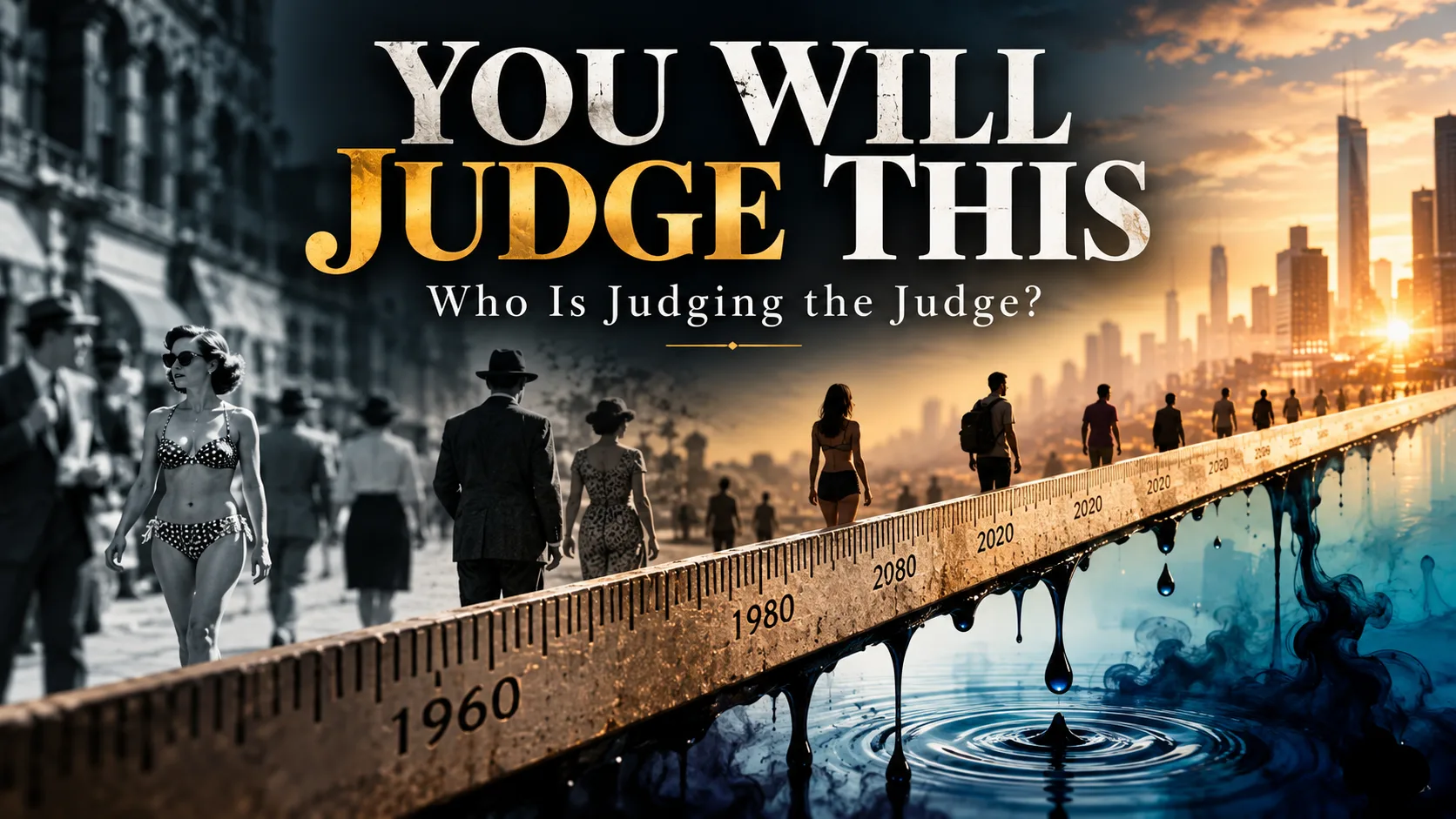
You Will Judge This
Before you reached this sentence, you had already judged something. But what if the deeper question is not whether we judge—but what inside us is doing the judging?
You have already started.
Perhaps you liked the title.
Perhaps it irritated you.
Perhaps you thought it sounded arrogant.
Perhaps you wondered what kind of person would write it.
You have barely begun.
You may know nothing about me.
Yet something has already happened.
You saw.
You compared.
You interpreted.
You concluded.
Don't worry.
I did the same thing when I imagined you reading this.
Before we have even met,
we have already judged each other.
Before Right and Wrong
Imagine you are walking down a street.
You look ahead and see a building.
You say:
That is a building.
Simple.
But who told you that?
Your eyes did not whisper the word building.
They gave you shapes, walls, openings, proportions, shadows and materials.
Your mind did the rest.
It compared what you saw with everything it had learned before and returned a conclusion:
Building.
And perhaps it is a building.
Almost certainly, it is.
But notice what happened.
Reality presented you with something.
Your mind gave it a name.
We normally call this recognition, not judgment.
Fair enough.
But perhaps judgment, in its widest sense, begins somewhere in that almost invisible distance between what exists in front of us and what our mind tells us it is.
Before good and bad.
Before beautiful and ugly.
Before acceptable and unacceptable.
First comes something more fundamental:
What is this thing in front of me?
We see.
We compare.
We recognize.
We interpret.
We conclude.
Most of the time, this process serves us remarkably well.
But it leaves behind one uncomfortable possibility:
What if what I am certain I see is partly what my mind has learned to see?
Keep that question.
We will need it later.
Now replace the building with a human being.
Everything becomes more complicated.
You Entered My Field of Vision
We often say:
"You don't know me. Don't judge me."
There is truth in that sentence.
But there is also a problem.
The moment I leave complete privacy and become visible to another human being, I enter someone else's field of vision.
They see my clothes.
My language.
My behaviour.
My silence.
How I treat the waiter.
How I speak to my family.
How I respond when I am angry.
What I display.
What I hide badly.
I did not give them permission to judge me.
But the mind does not ask permission to perceive.
And perception rarely remains empty for long.
I might say:
"Why are you looking at me?"
Yet from the other side comes an uncomfortable answer:
"I wasn't searching for you. You appeared inside the world I was already looking at."
Visibility does not give anyone the right to invent facts about me.
But visibility creates interpretation.
And interpretation creates judgment.
So the loop begins.
How Far Did Your Judgment Travel?
Suppose I see a woman crossing the street wearing extremely revealing clothes.
I can observe:
Her clothes are revealing.
Then my reference enters.
Perhaps my religion tells me something about modesty.
Perhaps my culture does.
Perhaps my upbringing does.
Through that reference, I may conclude:
What she is wearing is wrong.
I have moved from observation to judgment.
But suppose I continue:
Therefore, she must be an immoral woman.
Something important has happened.
I have travelled beyond what I saw.
I moved from:
what was visible
to
what my reference said about what was visible
and finally to
something I did not actually know about the person.
Perhaps she notices my reaction.
She looks at me and thinks:
What an intolerant, backward man.
And suddenly she may have made the same journey in the opposite direction.
She has judged the man who judged her for being judgmental.
He interpreted her through his reference.
She interpreted him through hers.
Both may feel certain.
Both may feel offended.
Both may believe the other crossed the boundary.
And both may go home thinking:
People should stop judging others.
But perhaps the problem was never judgment itself.
Perhaps the problem began when:
our judgment travelled farther than our knowledge.
Someone who sees me for five seconds has five seconds of evidence.
Someone who speaks with me for an hour has more.
Someone who has known me for twenty years has more still.
Distance changes what is available to judgment.
Yet even the person closest to me does not possess my entire interior world.
There are rooms inside every human being that nobody else has entered.
Sometimes not even ourselves.
So perhaps we should learn to separate three things:
What I saw.
What my reference says about what I saw.
What I assumed about what I could not see.
They are not the same.
We behave as though they are.
The Invisible Ruler
No judgment appears from nowhere.
Behind it stands a reference.
Religion.
Culture.
Identity.
Family.
Education.
Experience.
History.
Pain.
Memory.
Society.
Desire.
Fear.
Perhaps several at once.
The reference is the invisible ruler in our hands.
We rarely notice it while measuring.
We simply measure.
Two people can witness the same event and leave carrying completely different meanings.
Their eyes may have received the same image.
Their rulers were different.
And the more deeply we believe in a reference, the more strongly it may shape what we conclude.
But there is a problem more difficult than disagreement.
What happens when the ruler itself begins to change?
When Judgment Changes Direction
In 1961, Australian television preserved a remarkable little moment.
A reporter went into the streets and asked ordinary people:
Should the bikini be banned?
The question belonged to a real social debate. Years earlier, Australian beach inspectors had ordered bikini-clad women off beaches.
Now forget for a moment who was right.
That is not the interesting part.
Imagine those people standing on many beaches today.
The human body did not fundamentally change.
The garment is still recognizable.
Yet the judgment surrounding it can be radically different.
What changed?
Not merely the clothes.
The reference through which the clothes acquired meaning changed.
What one generation experiences as shocking may be tolerated by another.
What is tolerated may become familiar.
What becomes familiar may become ordinary.
And eventually something fascinating can happen:
judgment changes direction.
The person wearing something once condemned may attract little attention.
The person strongly condemning it may now become the one being judged.
Judgment did not disappear.
The ruler moved.
Now imagine someone today watching those people from 1961.
Perhaps he laughs.
Perhaps he asks:
How could people have thought like that?
But look carefully.
The people of 1961 judged through the reference available to them.
The viewer today judges them through the reference available to him.
More than sixty years apart, they are still judging each other.
Which leaves a much less comfortable question:
What are we completely certain about today that someone sixty years from now may find incomprehensible?
And why are we so certain that our ruler has finally reached its permanent length?
One Drop at a Time
Tolerance is not necessarily surrender.
Different cultures can meet without disappearing.
Different religions can coexist.
Encountering another worldview can even strengthen identity by forcing us to understand why we believe what we believe.
But there is another possibility.
A quieter one.
Tolerance begins:
"I disagree with this, but I accept that you live differently from me."
Then comes familiarity.
"I see it often."
Then normality.
"It no longer surprises me."
Then another generation arrives.
They never experienced the original disagreement.
They inherited only the normality.
The grandfather says:
"I disagree, but I tolerate it."
The father says:
"It doesn't bother me anymore."
The child asks:
"Why did it ever bother anyone?"
Nobody necessarily betrayed anything consciously.
Nobody announced:
Today I will abandon my culture.
Nobody held a funeral for an identity.
Nobody woke up and decided:
Today I will forget my religion.
The boundary simply moved.
A little.
Then a little more.
Imagine a glass of clear water.
One drop of ink falls into it.
You notice.
Another.
You still notice.
Then another.
There is no explosion.
Nothing breaks.
And because every individual drop is small, there may never be one dramatic moment when somebody can point and say:
There. That was when the water changed.
Now imagine a child born after the hundredth drop.
To him, this is simply the colour of water.
His father remembers it slightly lighter.
His grandfather remembers something lighter still.
Nobody needs to be dishonest.
They simply remember different water.
But change is not automatically corruption.
Old references can contain mistakes.
New ideas can expose injustice.
Cultures can learn.
Traditions can preserve wisdom—and preserve errors.
People can misunderstand the very religion they claim to defend.
So the question cannot be:
How do we stop every drop?
Nor can it be:
How do we accept every drop?
The harder question is:
How do we distinguish correction from dilution?
And that becomes much harder when the thing we use to answer the question is changing too.
Measure the Ruler
Imagine owning a ruler.
Every year it becomes one millimetre shorter.
You do not know.
You continue measuring everything around you.
The numbers still appear.
Your measurements remain internally consistent.
The ruler still looks like the ruler you used yesterday.
Twenty years pass.
Someone asks:
Are you certain your ruler is still the same length?
Of course.
So you decide to measure it.
But with what?
Another ruler?
And where did that ruler come from?
The same society?
The same generation?
The same changing world?
Here lies the deeper problem:
If the reference by which we measure change is itself changing, how do we measure the change?
We might compare ourselves with our memories.
But our memories travelled with us.
We might compare ourselves with society.
But society travelled too.
We might compare ourselves with our parents.
But perhaps their ruler had already changed before they handed it to us.
And eventually we arrive at words we repeat confidently:
My religion.
My culture.
My identity.
But what exactly remains behind those names?
Do we know?
Or have we preserved the title while slowly forgetting the reference?
Perhaps an identity does not always disappear when its reference weakens.
Sometimes the name survives perfectly.
A person says:
I am a believer.
But what does that belief actually require from him?
Another says:
This is my culture.
But which part?
Why?
Another says:
This is who I am.
But who constructed that I?
Family?
Religion?
Culture?
Experience?
Society?
Fear?
Desire?
The century in which he happened to be born?
An identity can survive as a word long after its meaning has changed.
And perhaps that is harder to recognize than losing it completely.
Because nothing appears missing.
The name is still there.
When Desire Becomes the Judge
Human beings have always desired.
Desire is not the enemy.
But something changes when desire stops being something we judge and becomes the thing by which we judge everything else.
I want it.
I enjoy it.
It makes me comfortable.
It makes me happy.
It is my choice.
Therefore...
why should I question it?
Perhaps I should not.
Perhaps I should.
That is not the point.
The question is:
What remains outside the desire capable of examining it?
If wanting something becomes sufficient evidence that I should have it, desire becomes both defendant and judge.
The trial is over before it begins.
Who asks:
What will this make of me?
What will it do to someone else?
What kind of person will repeatedly choosing it create?
Perhaps freedom includes the ability to pursue desire.
But perhaps another kind of freedom exists:
the ability to stand outside your own desire long enough to judge it.
There is that word again.
When the Audience Leaves
Perhaps this is one reason I sometimes prefer solitude.
Not because being alone makes me better than other people.
Not because I stop judging them.
I will probably return and judge them again.
And they will judge me.
The loop is patient.
But solitude temporarily removes something powerful:
the audience.
Nobody to impress.
Nobody to defeat.
Nobody to persuade.
Nobody whose judgment requires an immediate defence.
Eventually the noise becomes quiet enough for another person to enter my field of vision.
Me.
And perhaps that is the most uncomfortable encounter.
Because when nobody else is available to condemn, convince or blame, I can ask:
What do I actually believe?
What do I reject?
What do I tolerate?
What do I desire?
What do I excuse?
What do I call my identity?
And how much of it do I truly understand?
Solitude does not free the world from my judgment.
It merely gives the judge an opportunity
to sit in the defendant's chair.
What We Leave Behind
A reference cannot remain invisible forever.
Eventually it becomes behaviour.
What I believe influences what I judge.
What I judge influences how I respond.
My response enters your life.
You interpret it through your reference.
You respond.
Something from you enters mine.
A child watches both of us.
A stranger remembers one sentence.
A friend changes slightly because of something we did.
A son inherits something his father never explained.
A daughter rejects something her mother never understood.
One generation normalizes something the previous generation merely tolerated.
And slowly,
yesterday's judgments become part of tomorrow's references.
Perhaps this is one of the deepest impacts we leave behind.
We do not leave only buildings, money, books or children.
We leave boundaries.
Things the next generation will consider normal.
Things they will consider strange.
Things they will admire.
Things they will condemn.
Things they may never realize were once questions.
And they will judge from there.
Follow Your Judgment Backwards
Perhaps you think you know your reference.
Maybe you do.
But there is one question I cannot answer for you:
If your reference had been changing one drop at a time throughout your life, would you have noticed?
You could compare it with your memory.
But your memory grew inside the same changing world.
You could compare it with the people around you.
But they were standing in the same glass.
You could compare it with yourself.
But you changed too.
So perhaps before defending your judgment, condemning mine, or demanding that somebody else stop judging you, there is another journey worth making.
Follow your judgment backwards.
Past the conclusion.
Past the anger.
Past the attraction.
Past the disgust.
Past the desire.
Past the habit.
Past what everyone around you calls normal.
Keep going.
Until you reach the reference.
Then ask:
Where did this come from?
Do I understand it?
Did I choose it?
Did I inherit it?
Did I change it consciously?
Or did it change so slowly that I simply travelled with it?
And eventually:
What should judge the judge?
I will not answer that for you.
Because the moment I tell you what your final reference should be—religion, culture, reason, conscience, tradition, philosophy—I place my ruler in your hand.
This journey is not about my answer.
It is about whether you have examined yours.
You Judged This
And now you have reached the end.
Perhaps you agree.
Perhaps you strongly disagree.
Perhaps one paragraph irritated you.
Perhaps another stayed with you.
Perhaps you have already decided what kind of person wrote this.
Look at what happened.
You saw these words.
You compared them with something already inside you.
You gave them meaning.
You reached a conclusion.
You judged.
Of course you did.
The question was never whether you would.
The question is:
What judged them inside you?
And if the answer comes immediately,
go one step deeper:
Who taught the judge?
And deeper still:
If the judge itself has been changing, who would have noticed?
Perhaps you have an answer.
I have mine.
But the moment I tell you what it is,
you will judge my answer through yours,
and I may judge your judgment through mine.
And there we are again.
Exactly where we started.
See.
Be seen.
Judge.
Be judged.
Change someone.
Be changed.
Leave something behind.
And every once in a while,
before measuring the whole world,
look at the ruler in your hand.
Not to stop judging.
That was never the point.
But to ask whether you still know
what is doing the judging.
The journey continues.
Before measuring the whole world, look at the ruler in your hand.
How did this make you feel?
Tap a sentiment to echo your reflection through this piece.
Continue the Journey
Go back to the full Journey page to explore more reflections, stories behind the songs, and writings from the books.
Back to The Journey
Leave Your Reflection
Share a thought, a memory, or a feeling this piece awakened in you.